


Similar but very different...
Here are two lions. Both are walking straight towards you, and both are bathed in the kind of early-morning African light that seems to belong to Africa alone. Either could look fine on a wall. But only one was there.
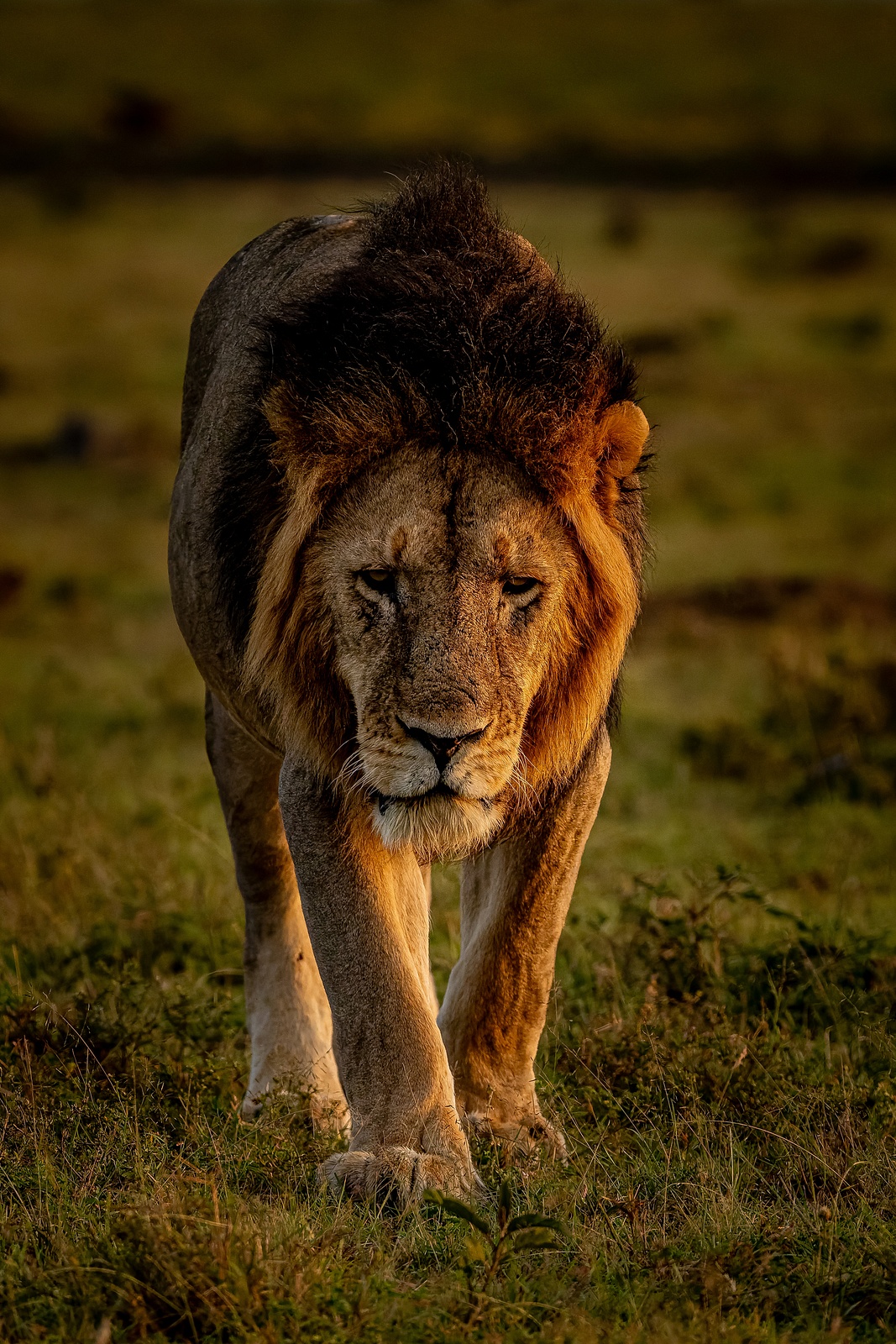
This is the real lion. He and another male were walking towards our Toyota Land Cruiser while I photographed from the floor of the vehicle. The encounter took place in Kenya, after a journey that involved a substantial investment in camera gear and several very early mornings. The animal’s direct approach gave the moment an intensity no prompt could reproduce.

This one began with a sentence I typed into my smartphone while I was in the bath (don’t ask). About as long as it takes to turn off the hot tap later, a magnificent, glossy lion had appeared—entirely fictional. The two images set up an awkward question: if a sentence can produce a lion like this, what did I buy with all those thousands of pounds I spent going to Kenya?
For many people, the fake may be the more appealing picture: a better sky, no scars, brighter eyes, and a mane that looks as if it has seen a stylist. I’ll tell you which is which in a moment. First, though, a confession: the real photograph was never the only thing I brought back.
The receipt, not the purchase
The photograph is the receipt. The experience is what I actually bought.
1. Adrenaline and focus
A lion walking directly towards your vehicle commands your attention in a way no screen can. My heart rate certainly noticed. I had a guide who knew his business, the solid bulk of a Toyota around me, and a camera routine I could carry out without thinking: expose, focus, frame. That routine gave me something useful to do, leaving my mind free to look.
The fake lion brought no fright at all. The only risk was getting bubble-bath bubbles on my phone.

Molecular structure of Adrenaline (Epinephrine) - Small thing - MASSIVE experience!
2. Flow.
When a subject is moving, the light is changing, and there may be only one chance, attention narrows to the task. Psychologists call this state “flow”: the work is demanding enough to absorb you, but not so difficult that you are overwhelmed. Typing a sentence carries no real threat; an adult male lion looking for breakfast certainly does. That sense of risk was part of what made the experience so absorbing.
3. The chance to get it wrong.
I could have missed the lion: the wrong shutter speed, the lens cap still on, or my attention fixed on a warthog in the other direction. It happens. That possibility is part of the point. If you cannot fail, you cannot truly succeed either. Nobody ever punched the air over a prompt.
4. Being made to feel small.
The real lion did not care about me one jot. He had somewhere to be; I was, at best, furniture and, at worst, breakfast. There is something oddly restful about that.
The AI lion, by contrast, exists only because I asked for him. He is the most obliging lion in history, and it is hard to feel awe towards something that does exactly as it is told.
5. Back injury or cold water.
I earned that photograph by working with the guide to anticipate the lion’s direction and decide where we should be. Then I lay flat on my stomach on the vehicle floor, stretching my thoracolumbar spine to get as low as possible. I came close to a spondylolytic fracture of T12 or L1. Alongside fear, discomfort is also recognised as a contributor to flow.
For the other lion, I was in the bath, dictating to ChatGPT. That was the whole process. The greatest risk was getting cold as the water cooled. That is the whole memory attached to image number two.
And that is not counting the months of anticipation, learning a new kind of photography, or telling the story afterwards—though my family may feel I have told it often enough.
All of that matters to me. But what about you? You were not in the Land Cruiser. You are looking at a screen. Does it make any difference whether the lion was real?
It is a harder question than it first appears, and I’ll begin by conceding a point. If all you want from a picture is a moment of calm, the pretty fake may do the job. Your optic nerve does not check provenance. Studies show that people value the very same image less when they are told a machine made it.
There is a famous cautionary tale from the 1930s and 1940s. Han van Meegeren, a Dutchman, painted “Vermeers” that fooled experts and were admired—until he confessed. Not a brushstroke changed after the confession. Yet the paintings stopped working for people, and interest in them vanished.
I don’t think calm is all a photograph can offer. I can explain why with a beach photograph.
It's the person not the camera...
Many years ago, I attended a photography course run by Colin Prior, a fantastic landscape photographer and coach. On the Friday evening, as we gathered, he opened his presentation with a photograph of the Bay of Laig on the Isle of Eigg. Great, rounded boulders sat on the shore like something a giant had left behind. He called it the Giant's Chessboard. The linked page may or may not show the photograph I saw that evening, but it gives you the idea.
Then he told us he had taken it on his phone. This was many years ago, and the camera in that early iPhone would be laughed at by smartphone users today. It didn’t matter. I had the same kind of phone, and I could go to that place. The photograph made the possibility feel real.
There is also an old story—and I must stress that it is a story—about Ernest Hemingway dining with the great landscape photographer Ansel Adams. “You take the most amazing pictures,” Hemingway is said to have remarked. “What kind of camera do you use?” Adams supposedly thought for a moment, then replied: “You write the most amazing stories. What kind of typewriter do you use?”
 Ansell Adams
 Ernest Hemingway
It almost certainly never happened. In a post about telling the real from the fake, I should say so. But the apocryphal story has lasted because it gets at something true. Another line usually credited to Adams makes the same point: the single most important component of a camera is the twelve inches behind it.
That photograph of Eigg had lodged quietly in my mind. It seemed to say: “This place exists. Someone stood here. You could too.”
Last year, I finally did. I went on one of Colin’s trips to the Hebrides, landed on Eigg, and stood on that same shore.

His photograph is better. But making my own gave me an extraordinary sense of fulfilment—the first time I had felt that so strongly with a camera in my hand.
Now reverse the thought experiment. Suppose the photograph Colin showed us that Friday evening had been AI-generated: the same boulders, the same light, everything the same. Would I have gone? Gone where? There would have been no shore to stand on.
That, I think, is what a real photograph can give someone who was not there:
- Evidence. This happened. The world really contains this. Your wonder is directed towards the world; the picture is only the window.
- Somebody, not anybody. My lion is one particular animal, with his own scars and his own bad temper. The other is an average of lions in photographs, which makes him no particular lion at all.
- Company. Another human being noticed this and thought you should see it. We are not just looking at pictures; we are looking for one another.
- An invitation. A real photograph can say, “Go.” A fake one can only say, “Type something else.”
Trust
Everything a photograph can offer someone who was not there depends on being able to trust it. The more fakes there are, the more we question what we see—and it is hard to feel awe while wondering whether something is real. Saying plainly which photograph is real and which is not is no footnote. It is part of the gift.
That brings me back to Hemingway—or, this time, to a real letter he wrote in 1953:
"You cannot stop trusting people in life but I have learned to be a little bit careful. The way to make people trust-worthy is to trust them."
I love that thought because it cuts both ways. You cannot check my pixels; nobody can, not any more. The days of “the camera never lies” are well and truly over. Trust has shifted: it used to sit in the photograph, and now it sits with the photographer.
When you look at my lion and take my word for it, you lend me something precious. Hemingway’s point is that the trust itself is what should make me worthy of it.
And I should be “a little bit careful” too. I am not claiming purity: every photograph of mine is edited. Ansel Adams also spent hours in the darkroom coaxing his prints into shape. There is a difference between shaping a photograph and lying about it. Brighten the shadows by all means; change the light by all means. But do not put something in that was not there.

This Serval was spotted by our safari guide in Amboseli not long after arriving. Yes - I removed a blade of grass from its face in post-processing, to make the image sing but that's it - a blade of grass. This rare animal, and even rarer sighting, was captured by chance thanks to a guide of the highest quality. If you go to Amboseli, you might not see this - but you'll have a ball - trust me!
That is my side of the bargain: if I tell you I was there, I was there. I have an AI policy, which you can read on this website.
"My" lion and what I can offer...
My lion is the scruffy one, with scars on his face, flies around his eyes, and the mane of an animal that has slept just a few yards away. He is real, and so was the morning—complete with the adrenaline rush I experienced.
I was there. I felt the adrenaline as the lion looked at me and walked straight towards me. I was in a flow state unlike anything I had experienced previously let alone with a camera, and I am proud to have the memory. What I can offer you is smaller, but I hope it is still worth having: proof that mornings like that are still out there, and that one of them might be yours. It need not involve a lion, though I would love it if it did.
Happy travelling and happy shooting!
Warm regards,
Colin
#AI generated images #African wildlife photography #Colin Scott Photography #Kenya safari photography #authenticity in photography #lion photography #photographic truth #photography and AI #photography ethics #real photographs #real vs AI photography #travel photography #trust in photography #wildlife photography
 ) to see how your blog looks